
If you’ve ever stepped inside a metal building in July, you already know the feeling. It’s like climbing into a pickup that’s been sitting in a Walmart parking lot all afternoon. And come the first cold snap, that same building turns into a giant icebox that eats up every dollar of heat you pump into it.
That’s the trade-off with steel. It’s tough, it goes up fast, and it holds up against Texas weather. But on its own, it does a terrible job of keeping heat out in summer and in during winter. The good news is that insulating a metal building is very doable, and the right approach depends on a few things: whether the building is new or already standing, the way you use it, along with how much you’re ready to spend.
This guide walks through all of it in plain talk. We’ll cover the materials, the roof, the walls, the ceiling, the condensation problem that catches almost everybody off guard, and what to do if your building has been standing for years. If you’d rather skip the reading and get a number, you can call us at (214) 240-8322 or request a free consultation.
Quick answer: what’s the best way to insulate a metal building?
For most Texas metal buildings, closed-cell spray foam applied directly to the underside of the roof and walls gives the best mix of insulation, air sealing and moisture control. If the budget is tight, faced fiberglass rolls or batts installed with a proper vapor barrier is the cheapest route that still works when it’s done carefully. Rigid foam board sits in the middle and works well where space is limited.
There’s no single winner for every building, so keep reading to match the method to your situation.
Why metal buildings become so hot, cold and Wet inside
Steel conducts heat very quickly. When the sun shines hard on a metal roof, that heat passes right through into the building. When the temperature drops at night, the metal cools off fast and pulls warmth out of the space just as quickly.
The second problem is condensation, and it’s the one that does the real damage. Texas air carries a lot of moisture, especially across East and North Texas. When warm, humid air inside the building touches a cold metal surface, water forms on it. Think of a glass of sweet tea sweating on the porch. Now picture that happening along the whole underside of your roof. That drip can rust fasteners, soak stored items, and grow mold in the corners.
Insulation fixes both problems, but only if it also controls moisture. That’s why the details below matter.
What insulating a metal building actually gets you
- Lower energy bills. A building that holds its temperature makes your AC and heater work a lot less.
- Less condensation and rust. Tools, equipment, hay, feed and vehicles stay drier.
- A quieter space. Rain on a bare metal roof sounds like a drum solo. Insulation reduces the impact, and it helps if you run a shop, gym, or hobby space.
- A building you can really use. Plenty of folks around Kaufman County and Henderson County turn metal buildings into workshops, man caves and barndominiums. None of that works well at 105 degrees inside.
The U.S. Department of Energy has a solid overview of how insulation works and why R-value matters. You can read it on the DOE Energy Saver insulation page.
Insulation options for metal buildings, side by side
Here’s how the common choices stack up. R-values are rough, typical figures per inch, so always check the product label or manufacturer data sheet for the exact number.
| Material | Rough R-value per inch | Moisture control | Cost level | Best for |
| Closed-cell spray foam | About R-6 to R-7 | Excellent, acts as air and vapor barrier | Higher | Roofs, walls, retrofits, humid areas |
| Open-cell spray foam | About R-3.5 | Good air seal, not a vapor barrier | Medium | Interior walls and ceilings in conditioned spaces |
| Faced fiberglass rolls or batts | About R-3 to R-3.5 | Depends on facing and sealed seams | Lowest | New builds, tight budgets |
| Rigid foam board | About R-4 to R-6.5 depending on type | Good when seams are taped | Medium | Walls, limited space |
| Reflective or bubble insulation | Low on its own | Blocks radiant heat, needs an air gap | Low | Add-on for hot roofs, not a stand-alone fix |
Let’s go through the main ones.
Spray foam
Spray foam is applied as a liquid and then expands to fill every seam, gap, and ridge. On a metal building, that matters a lot, because the ribbed panels leave plenty of nooks where air sneaks through. Closed-cell foam sticks directly to clean metal and creates a continuous layer, which is why it’s a favorite for roofs and for any building that fights condensation.
It costs more up front. But you’re getting insulation, air sealing and moisture control in one pass, and you aren’t paying for separate vapor barrier work. Want the full breakdown? Take a look at our spray foam insulation services and our post on the benefits of spray foam insulation.
If you’re weighing the two types, our page on open cell insulation explains where it fits and where it doesn’t.
Fiberglass rolls and batts
Fiberglass is the budget pick, and it can work well in a metal building when it’s installed right. The key word is right. Compressed, gapped or wet fiberglass loses a big chunk of its value. It also needs a good vapor barrier, because it doesn’t stop air or moisture on its own the way foam does.
Want to know how it behaves in a regular home? See what batts insulation is and how it boosts indoor comfort.
Rigid foam board
Foam boards are stiff panels you cut to fit between framing or over a wall. They resist moisture and give good R-value in a thin profile, so they’re handy where you don’t want to lose floor space. The weak spot is the seams. Tape and seal every joint, or air will find its way through.
Reflective (bubble) insulation
This stuff reflects radiant heat, which helps in hot climates. On its own, though, it doesn’t add much resistance to heat flow, and it needs an air gap to work properly. Treat it as a helper layer, not your whole plan.
How to insulate a metal building roof
If your budget only allows you to handle one part of the building, make it the roof. In a Texas summer, the roof takes the worst of the sun, and heat rises, so that’s where most of the trouble starts.
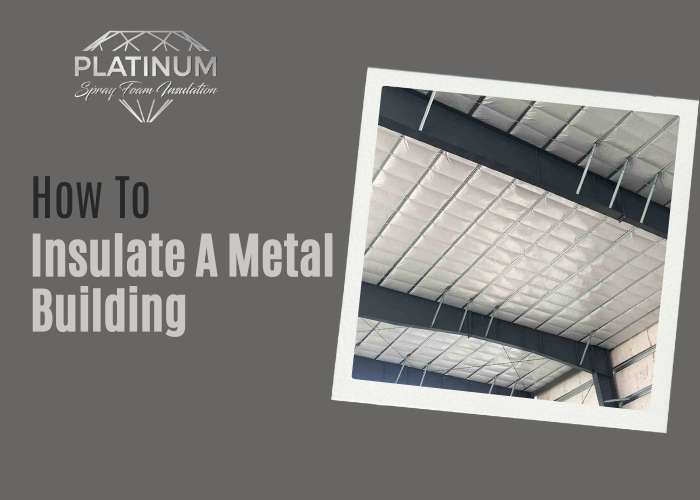
Apply spray foam to the underside of the roof deck. A technician applies closed-cell foam right onto the underside of the metal panels, covering the purlins and sealing the ribs. It deals with condensation better than anything else, since no cold surface is left for damp air to reach. This is also the preferred method for existing buildings.
Fiberglass with a liner. On new builds, long rolls of faced fiberglass get draped over the purlins before the roof goes on, with the facing acting as the vapor barrier. The seams need tape, and the insulation shouldn’t be squeezed down at the purlins or you lose R-value.
Rigid board under the panels. Less common on large roofs, but it’s an option on smaller buildings where you can fit boards between framing and seal every edge.
Watch out for sagging. Fiberglass that’s loose or wet will droop over time. Make sure it’s supported and stays dry.
How to insulate a metal building ceiling
If your metal building has a flat ceiling, like a shop or a barndominium with a framed-in ceiling, you have a second option. Instead of the roof deck, you can insulate the ceiling plane.
Blown-in insulation or batts on top of the ceiling works if the attic space above is vented or you’re not trying to condition it. Keep in mind this leaves the roof metal exposed to the heat above, so ventilation and a moisture plan matter more. If you want a sealed, conditioned space in a building, the cleaner option is usually to insulate at the roof line with spray foam.
How to insulate metal building walls
Walls are trickier than they look because of the girts, which are the horizontal supports that hold the wall panels. They create cold spots where heat bleeds straight through the steel.
A few ways to handle it:
- Apply spray foam to the inside surface of the wall panels. It closes up the corrugations and wraps around the girts. This is the most complete solution.
- Faced batts between girts, with a thermal break. A thin foam strip or thermal block over the girt helps keep heat from sneaking through the metal.
- Rigid foam board, taped at every seam, then covered with drywall, plywood or liner panels.
If you’re finishing the interior, our wall insulation service page covers how we approach it, and you can read about how wall insulation improves comfort.
How to insulate an existing metal building (retrofit)
This is one of the most common questions we hear: “My building’s already up. Can I still insulate it?” Yes, you can. Insulating after the fact is a bit different from doing it during construction, but it’s very doable.
Step 1: Look it over first. Check for rust, leaks, loose fasteners and any old insulation that’s wet, moldy or falling down. Fix roof leaks before you cover anything up. Insulation over a leaking roof just traps the problem.
Step 2: Deal with old insulation. If the existing material is damaged or soaked, it should come out. Our team handles insulation removal, and our post on signs you need professional insulation removal can help you decide.
Step 3: Clean the metal. Dust, grease and loose rust keep insulation from sticking. A clean surface makes a big difference with spray foam.
Step 4: Pick the right method. Spray foam is typically the best choice for retrofitting, since it is applied from the inside and does not mean you have to tear off the roof. Fiberglass retrofit kits and rigid boards can work too, but they take more labor and more care with moisture. Curious how foam works in finished spaces? See our answer on whether foam insulation can be installed in existing walls.
Step 5: Plan for finish and fire code. Depending on how you use the building, local code may call for a thermal barrier or ignition barrier over foam. Check with your local building department before you finish the interior.
If the insulation you already have is just worn out, a repair can cost far less than starting over. We explain why in why insulation repair service is more affordable, and you can learn about our insulation repair service here.
Stop condensation: vapor barriers and air gaps
Condensation is why so many DIY metal building insulation jobs go sideways. Here’s the simple version.
Warm, humid air carries water vapor. When that air reaches a cold surface, the vapor turns to liquid. Your aim is to stop humid air from ever coming into contact with cold metal.
There are two ways to do that:
- Seal the air and block the vapor. Closed-cell spray foam does both at once. For fiberglass, you need a continuous vapor barrier on the warm side, with every seam taped and every edge sealed.
- Keep metal from getting cold. Insulation that sits tight against the metal, with no gaps, stops the surface from dropping below the dew point.
A few common mistakes:
- Skipping the vapor barrier because the insulation has a facing (a torn or unsealed facing doesn’t count)
- Leaving gaps between rolls or batts
- Crushing fiberglass at the purlins
- Insulating over a roof that still leaks
For reflective insulation, you need an air gap to make it work. That’s one reason it’s not a stand-alone solution.
Insulating a metal garage, shed, shop or barn
Smaller buildings follow the same rules, but the details change.
Metal garage or shop. If you work out there, you want comfort and quiet. Spray foam on the roof and walls works well, and a finished interior with liner panels or drywall protects it. Don’t forget the garage door, which leaks a lot of air. Our guide on how to insulate a garage door covers that piece.
Metal shed. Sheds are small, so material costs stay low. Rigid foam or faced batts do the job for storage. If you plan to use it as a workspace, foam gives better results. Wondering what a typical project costs? We broke down how much it costs to insulate a 12×24 shed.
Barn, pole barn or barndominium. These are big, so the roof is where you’ll save the most. If people will live or work inside, go with spray foam so the whole envelope is sealed.
Cheapest insulation for a metal building
Let’s be straight about this. Fiberglass rolls or batts with a vapor barrier is the lowest-cost way to insulate a metal building. For a small, dry building where you just want to take the edge off the heat, it can be enough.
But cheap up front doesn’t always mean cheap over time. If condensation soaks the fiberglass, or gaps let air leak through, you’ll pay for it in energy bills and repairs. A building that stays dry and sealed usually costs less to own in the long run. For a deeper look at this, read platinum vs traditional insulation.
Since material prices, building size and access all affect the cost, the best way to get a real number is to have us take a quick look at your building. We offer free consultations.
How to insulate a metal building with batts or fiberglass: the basic steps
If you’re doing a small project yourself, this is the general order of work. Always follow the manufacturer’s instructions for your product.
- Measure and plan. Figure out your wall and roof area, and pick the R-value you need for your climate.
- Clean the surfaces. Remove dust, oil and loose rust.
- Install the vapor barrier or faced insulation. Keep the facing toward the warm, conditioned side in most cases, and tape every seam.
- Fit the insulation snugly. No gaps, no folds, no squeezing it into spaces too small for it.
- Seal the edges and penetrations. Corners, door frames and vents are where leaks start.
- Cover it. Liner panels, drywall or plywood protect the insulation and give you a finished look.
Tools and materials you’ll typically need: utility knife, tape measure, staple gun or fastening system, vapor barrier tape, gloves, safety glasses and a dust mask. For a roof or tall wall, you’ll also need a safe way to reach the work area.
What R-value do you need in Texas?
Most of North and East Texas, including the Dallas and Kaufman area, falls in what building codes call climate zone 3, which is hot and humid. Our summers put a heavy load on cooling, so roof insulation is usually the priority. The exact R-value you should target depends on your building’s use, whether it’s conditioned, and local code.
The Department of Energy publishes recommended R-values by region. You can use it as a starting point, then talk to a pro about what makes sense for your building. If you want a manufacturer’s perspective on metal building construction and standards, the Metal Building Manufacturers Association is a good place to start.
DIY or hire a pro?
You can handle a lot yourself. A small shed or a short wall run with fiberglass is a reasonable weekend project.
Spray foam is a different story. It involves specialized equipment, precise mixing, and safety gear, and mistakes are expensive and hard to undo. If you’re curious about the risks, our post on do-it-yourself spray-in foam insulation explains what to watch for, and where not to use spray foam insulation is worth a read too.
For large buildings, roofs and anything with a condensation history, hiring a professional usually saves money in the end.
Common mistakes to avoid
- Skipping the vapor barrier. Moisture is the number one enemy.
- Leaving gaps. Even small gaps let air through and cut performance.
- Choosing the wrong material for the job. What works in a shed may not work in a shop.
- Forgetting the roof. It’s where most heat gets in.
- Covering up a leak. Fix water problems before insulating.
- Ignoring fire and building codes. Check requirements for your use before you finish the space.
Frequently asked questions
How do you keep a metal building warm?
Start with good insulation on the roof and walls, then seal air leaks around doors, windows and panel edges. Spray foam does both jobs at once, and weatherproof caulk helps with the small stuff.
What is the most effective way to insulate a metal building that is already built?
Spraying closed-cell foam on the inside is typically the best choice for a retrofit, because it bonds to the metal and does not require removing the roof. First, repair any leaks and take out insulation that is wet or ruined.
Is it possible to spray foam right onto a metal roof or wall?
Yes. Closed-cell spray foam sticks well to metal that is clean and dry. Getting the surface ready is important, and a trained installer will look at the surface and conditions before spraying.
Is a vapor barrier necessary for a metal building?
If you’re using fiberglass, yes. A continuous, sealed vapor barrier keeps humid air from reaching the cold metal. Closed-cell spray foam acts as its own barrier.
Do you need an air gap behind insulation?
It depends on the material. Reflective insulation needs an air gap to work. Spray foam and tightly installed batts don’t rely on one.
Which insulation works best for metal building walls?
Closed-cell spray foam and taped rigid foam board both perform well, since they offer solid thermal resistance and help control condensation.
What’s the most affordable way to insulate a metal building?
Fiberglass rolls or batts with a facing and a sealed vapor barrier are the cheapest choice.
How long does foam insulation last?
When it’s installed properly and kept dry, spray foam can last for decades. We cover this in how long foam insulation lasts.
Talk to a local insulation team
Insulating a metal building isn’t complicated, but the small details decide whether it works for twenty years or leaves you with drips and rust in two. If you’d like someone to look at your building and tell you what makes sense, Platinum Spray Foam is happy to help.
We work with homeowners and property owners across North and East Texas, including Ennis, Waxahachie, Kaufman, Rockwall, Athens and Gun Barrel City. You can see our full service area, check out our reviews, or browse the project gallery.
Ready for a straight answer on your building? Request your free consultation or call (214) 240-8322.